2026/06/04, 2026/06/20, 2026/06/25, 2026/07/13, 2026/08/06, 2026/08/24, 2026/10/13
Nearly two years ago, phase 3 of launch was articulated here. Since October of 2024, I've been using 9menu as my primary program for launch. Moreover, Pdmenu has been launch's sole vehicle in my consoles for over a decade; until now, I neglected to document my application of it! Hereunder, I'll provide screenshots to illustrate how launch is currently arranged and accessed.
.pdmenurc's present size is 11184; 9menu-launch/*'s present size is 39973.
Anyone who's familiar with my avocations knows that I love to collect software, and that I've been doing so since 1992. As I haven't fully perused FreeBSD's repository and I'm still collecting old UNIX programs, DOOM WADs, Quake maps, and games for Atari 2600, DOS, NES, SNES, Amiga, etc., I've plenty more to accumulate. To readily launch programs and other resources, I need menus that are lightweight, efficient, and flexible. Pdmenu (in the console, and occasionally X) and 9menu (in X) are the programs that perform optimally in that capacity.
Pdmenu has been my sole menuing program in consoles of Minix and Debian, then FreeBSD for well over a decade. It's superior to any equivalents that I used in DOS, and since it's available in nearly every UNIX-like distro's repository and easily compilable, I expect to implement it indefinitely.
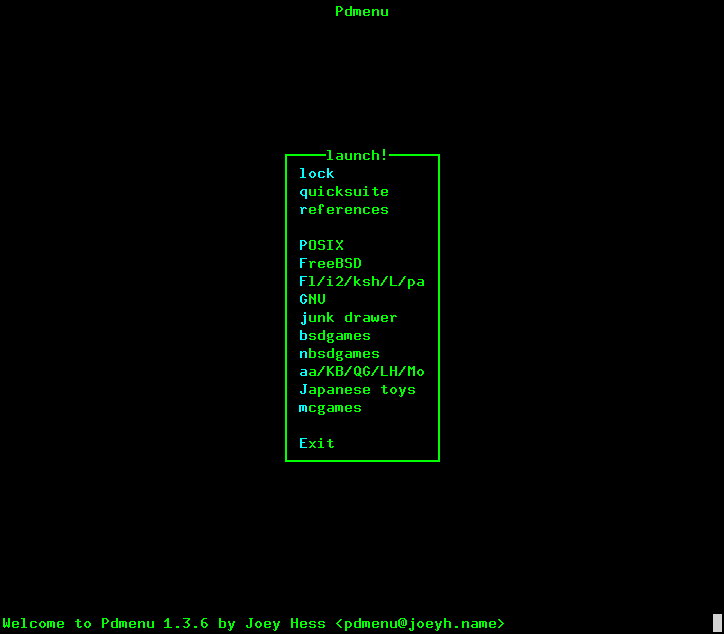
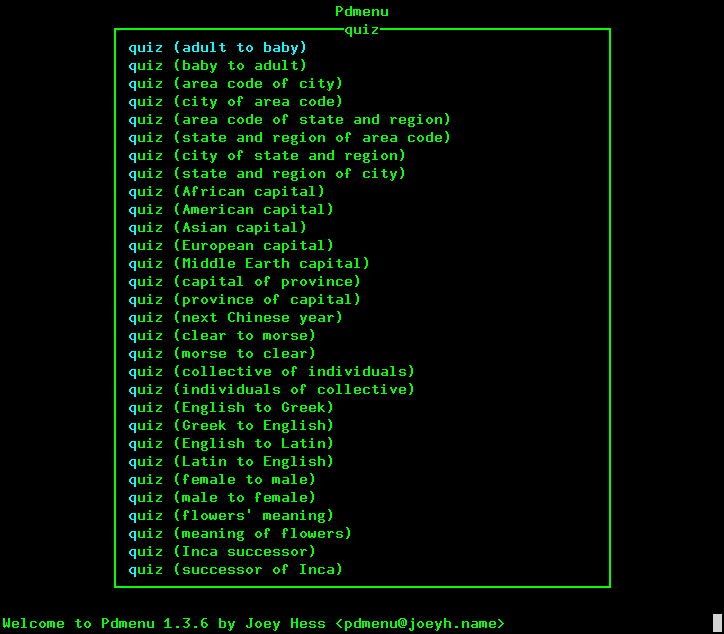
As in 9menu, launch is organized in Pdmenu by suites and other collections. Here's the main menu:
To maximize ease, lock, quicksuite, and references are respectively listed first, second, and third, so that I can lock the console immediately whenever necessary, and quickly access my most useful programs and references while working.
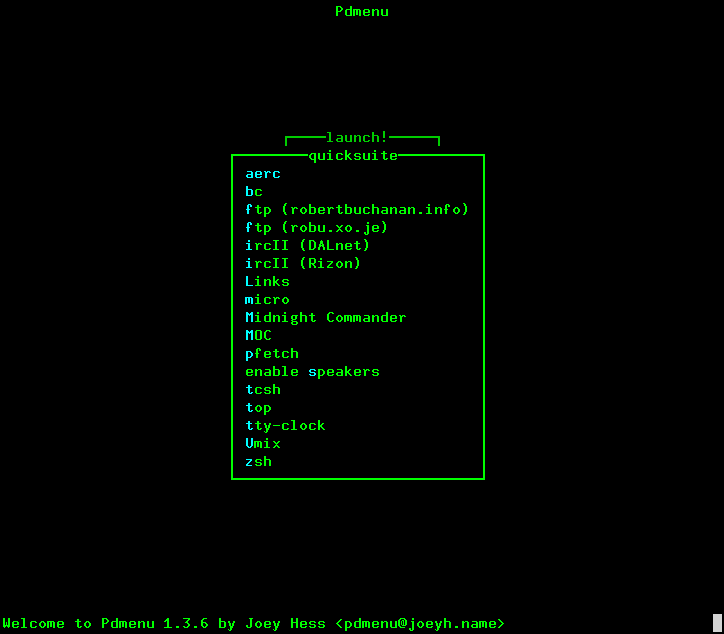
Pictured above, quicksuite is the single most important menu of launch, where I execute my most useful programs.
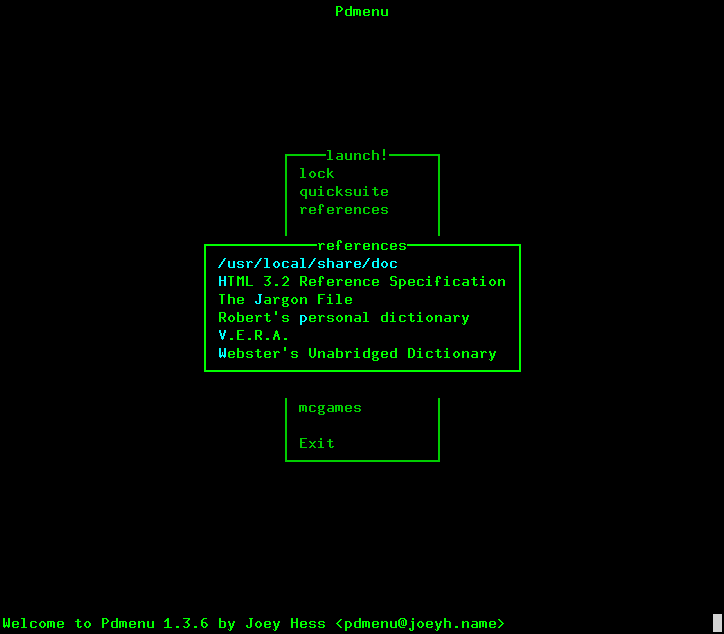
Most of the time, I just use references to access my dictionary or Webster's gargantuanly unabridged dictionary while working. Less often, documentation is accessed whenever I need to learn or recall some minutia about a program's functions.
These programs require scant introduction and no explanations.





This is what my X/mcwm looks like when it's launched:

Since my 9menus encompass most of the items listed in Pdmenu and hundreds more that run under X, they're far larger and slightly more sophisticated.


Here, quicksuite lists more programs. xtrlock tops the list, as lock is nigh-useless in X. thingylaunch is handy when testing new programs or just executing something differently. Quake and XEvil are itemized because I won't pick through 2 to 3 menus for games that I play nearly every day. In X, Directory is launch's hub. Note that Directory and quicksuite can be launched from each other in case either is accidentally closed.
Many of these menus are consubstantial to those in Pdmenu; others are expanded, or exclusive to 9menu.

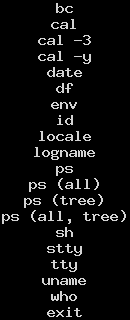

Obviously, POSIX isn't subject to change. Of course, FreeBSD is unique to installations of FreeBSD on my machines; this menu will be disused but retained on future installations of OpenBSD, NetBSD, Slackware, etc. Therein, it'll be replaced by 9menus listing programs exclusive to those operating systems. On installations of Linux flavors, some will be featured in GNU (see below).


X's contents will only ever differ for varied availability. As GTK2 is being phased out in favor of ghastly GTK3 and GTK4, vtes may be excluded in the future, unless I take the time to compile GTK2, vte, and its offspring from their respective sources. Who can say?


Offices originally contained both OpenOffice and LibreOffice, but cultists of GNOME have yoked godforsaken GTK3 as a dependency of Qt6 in FreeBSD's repository, and I won't submit to their insanity. LibreOffice's programs are and will be hashed out in its 9menu's file until I compile it from source without that trash. Ugh! It'll be back.

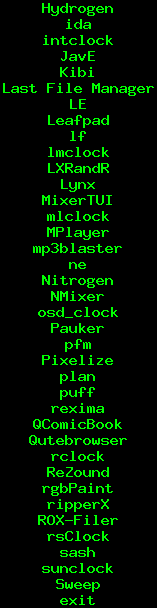


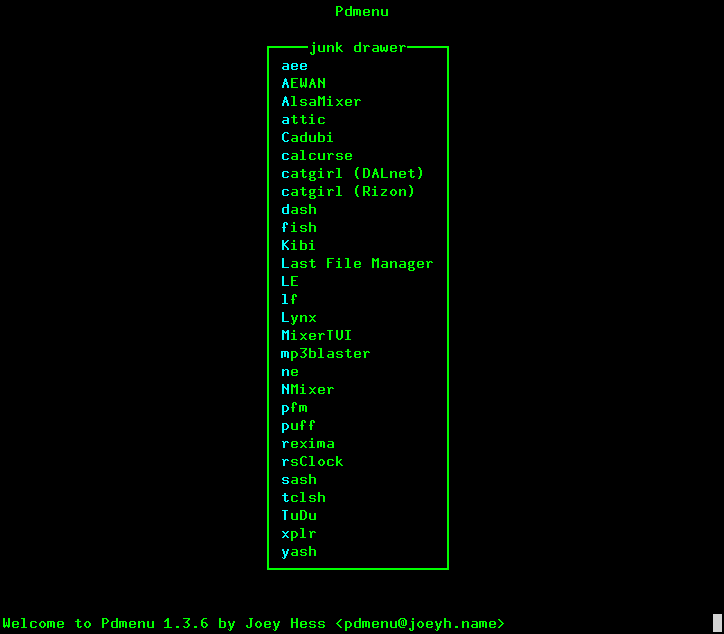
The junk drawers are packed with great tools that I use with varying frequency.


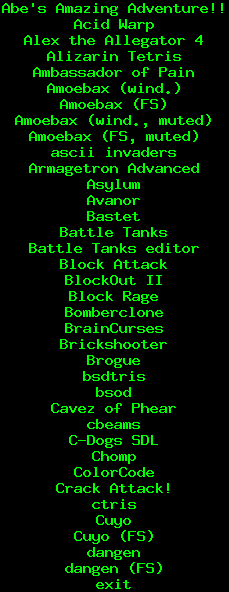
Classics new and old abound in bsdgames and nbsdgames, here shorn of the programs that I dislike.


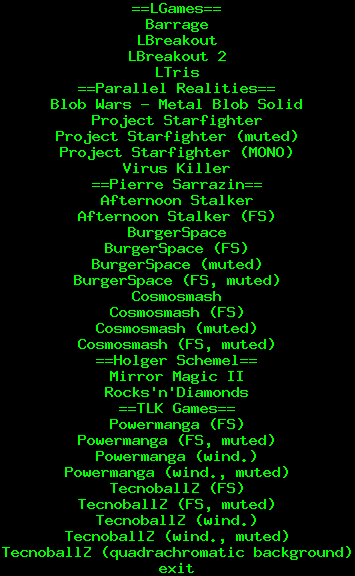


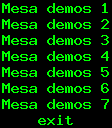
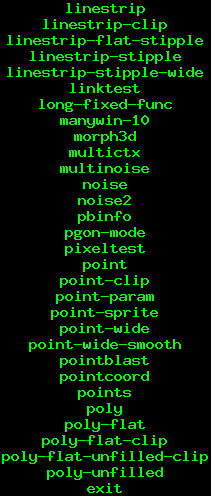
Mesa demos is a massive suite: hundreds of programs cataloged in a whopping seven 9menus!




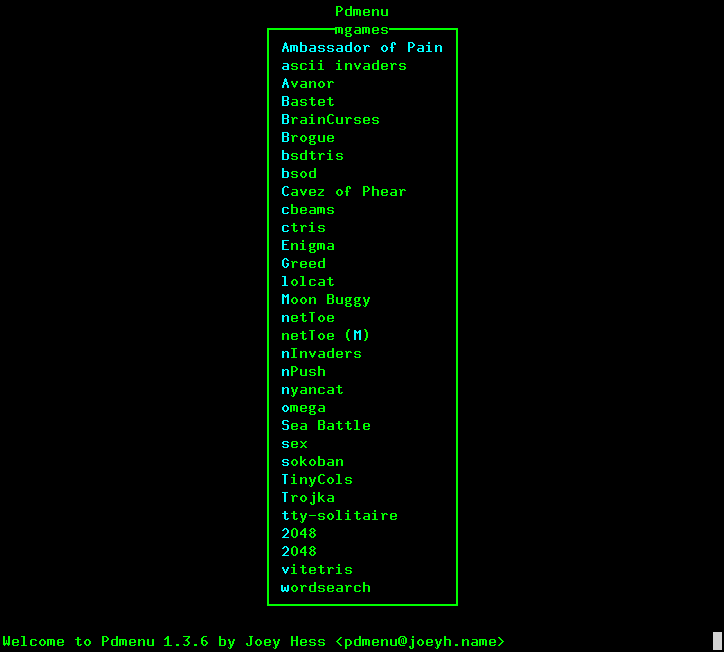
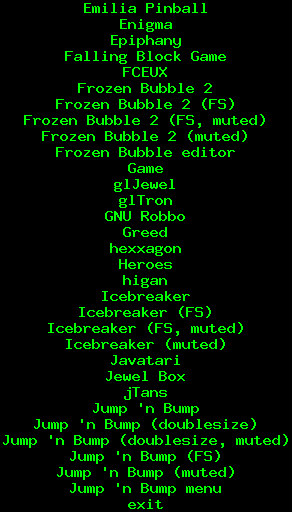
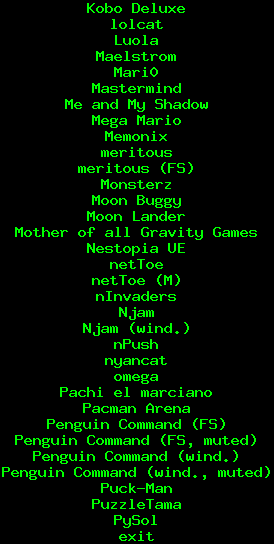
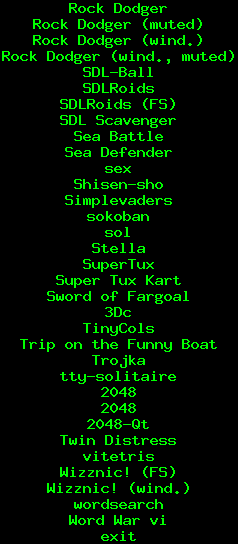
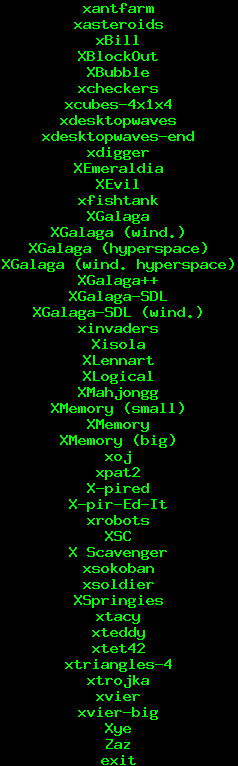
M stands for miscellaneous; as in Pdmenu (see above), menus of mgames list games that haven't a place elsewhere.


© 2026 Robert Buchanan